
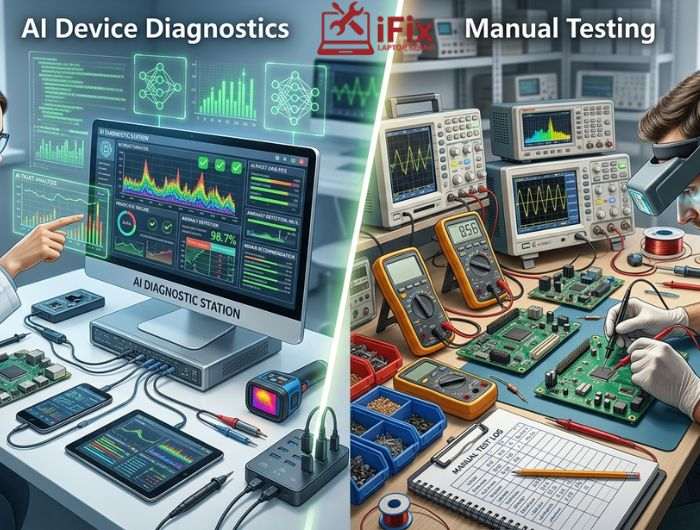
AI device diagnostics vs manual testing is a growing conversation as devices become more advanced and harder to troubleshoot. From smartphones to laptops, modern systems require smarter ways to detect faults quickly and accurately.
Traditionally, technicians relied on manual device troubleshooting, while automated phone diagnostics now offer faster, data-driven insights.
According to industry research, AI can reach 85–95% accuracy, but professional device inspection remains essential for deeper evaluation and reliable results.
So, which method is actually more reliable? Let’s explore both in detail.
What is Manual Device Testing?
Manual testing refers to a hands-on process where technicians physically inspect and test a device. This includes:
- Checking hardware components like the battery, screen, and ports
- Running software diagnostics manually
- Observing device behavior in real-world scenarios
Strengths of Manual Testing
- Strong human judgment and experience
- Better at detecting unusual or rare issues
- Essential for smartphone hardware testing
- Ideal for UX-related problems
Limitations
- Time-consuming and slower
- Can vary depending on the technician’s skill
- Risk of human error or missed issues
Manual testing still plays a big role in accurate phone diagnostics, especially when problems are not obvious or repeatable.
What is AI-Powered Device Diagnostics?
AI diagnostics use advanced algorithms and AI repair software tools to automatically scan devices and identify faults.
These systems work by:
- Running automated tests across hardware and software
- Comparing results with large datasets
- Identifying patterns linked to known issues
Key Capabilities
- Fast and scalable automated phone diagnostics
- Consistent results without human variation
- Ability to detect hidden or early-stage issues
- Useful for bulk device testing
A report by IBM highlights that AI-driven systems reduce diagnostic errors and improve efficiency across technical industries.
→ If your device isn’t performing properly, a deeper check can reveal hidden issues.
AI Device Diagnostics vs Manual Testing: A Deeper Accuracy Comparison
When analyzing AI device diagnostics vs manual testing, accuracy depends on the situation rather than a single clear winner.
Where AI is More Accurate
- Detecting repeated issues like battery degradation
- Running large-scale diagnostics with consistency
- Identifying hidden faults using data patterns
- Reducing human error
In these scenarios, AI improves accurate phone diagnostics by providing reliable and repeatable results.
Where Manual Testing Is More Accurate
- Diagnosing rare or unpredictable issues
- Evaluating real-world performance problems
- Handling physical damage or hardware irregularities
- Understanding user-reported issues
Here, manual device troubleshooting provides deeper insight that AI cannot fully replicate.
Speed vs Depth: A Practical Perspective
Another important factor in AI device diagnostics vs manual testing is how quickly each method works.
- AI diagnostics can scan a device within seconds, making it ideal for high-volume environments.
- Manual testing takes longer but allows technicians to explore problems in detail.
For example, in repair shops handling many devices daily, AI helps speed up the initial process. However, technicians often follow up with manual checks to confirm findings and ensure accurate phone diagnostics.
Not all issues are obvious from quick scans. A full check helps avoid bigger problems.
Challenges Comparison (AI vs Manual Testing)
Aspect | AI Diagnostics Challenges | Manual Testing Challenges |
Accuracy | May produce false positives in complex cases | Depends on the technician’s skill level |
Flexibility | Limited in handling unique or rare issues | Strong adaptability to unusual problems |
Speed | Fast but may miss context | Slow and time-intensive |
Consistency | Highly consistent results | Can vary between technicians |
Scalability | Easily scales across many devices | Difficult to scale efficiently |
Dependency | Relies on data quality and algorithms | Relies on human expertise and experience |
This comparison shows that both methods have limitations, which is why relying on only one approach can reduce overall effectiveness.
Why a Hybrid Approach Works Best
The discussion around AI device diagnostics vs manual testing is increasingly shifting toward a combined model.
How It Works in Practice
- AI performs initial scans using AI repair software tools
- Flags potential issues quickly
- The technician conducts a professional device inspection
- Final diagnosis is verified manually
This approach ensures both speed and depth, improving the chances of delivering accurate phone diagnostics.
In real repair environments, this often means starting with automated phone diagnostics and then confirming results through hands-on testing. If you’re running a repair service or dealing with recurring device issues, this combined method can significantly improve reliability and customer trust.
Using both AI tools and manual expertise delivers the most dependable results. If you’re unsure what’s affecting your device, contact us today to get expert advice. Getting expert input early can save time and cost.
Practical Use Cases for AI and Manual Device Testing
Scenario | Best Approach |
Bulk device testing | AI diagnostics |
Complex fault detection | Manual testing |
Preventive maintenance | AI tools |
Final quality check | Manual inspection |
Maximum accuracy | Hybrid approach |
Industry Trends and Insights
- Over 70% of repair businesses now use AI tools in some form
- AI diagnostics continue to improve with better datasets
- Hybrid testing is becoming the industry standard
If your device is slowing down, overheating, or facing repeated issues, it’s best to act before the problem worsens.
Conclusion
When evaluating AI device diagnostics vs manual testing, accuracy depends on using both effectively. AI offers speed, consistency, and efficiency, making it ideal for large-scale diagnostics, while manual testing provides human judgment and a deeper understanding of complex issues.
In practice, combining AI-driven detection with expert validation ensures more reliable results and delivers consistently accurate and dependable device diagnostics.
FAQs
- Can AI diagnostics detect software and hardware issues at the same time?
Yes, most AI tools can scan both software and hardware simultaneously, but hardware accuracy may still require manual verification.
- How reliable are AI diagnostics for older devices?
AI diagnostics can be less reliable for older devices due to limited or outdated training data, making manual checks more important.
- Do AI diagnostic tools require internet access to work?
Some AI tools work offline, but many require internet access to compare data with cloud-based databases for better accuracy.
- How long does a full manual device inspection usually take?
A complete manual inspection can take anywhere from 20 minutes to over an hour, depending on the complexity of the issue.
- Are AI diagnostic tools safe for personal data on devices?
Most reputable tools are designed to protect user data, but it’s important to use trusted software or professional services to avoid risks.
